A new consensus is forming in the post-quantum conversation: PQC isn't really a cryptography problem, it's a PKI problem. We hear it in conference talks, vendor webinars and certificate-management marketing, and it often shapes how organisations have scoped their programmes before we ever meet them. Fix your certificate visibility, automate your lifecycle management, mature your PKI operations, and quantum readiness will follow.
I understand why people say this, and much of it is true. But in our discovery work, the certificate estate is consistently the best-understood part of an organisation's cryptography, not the worst. The quantum exposure that should worry you most usually sits somewhere a certificate inventory never looks.
PQC is not a PKI project. PKI is one workstream inside a much larger one.
Where the PKI view is right
Credit where it's due. The PKI-first argument gets three things right.
First, the mathematics is not the bottleneck. NIST has published its standards, and nobody migrating a bank needs to understand lattice reduction. Second, operational discipline matters more than theory. An organisation that still loses production systems to expired certificates is not going to execute a clean algorithm migration. Third, automation and crypto-agility are prerequisites, not nice-to-haves. If rotating a key takes a change request and three weeks, rotating every key is a multi-year programme.
All of that is true. The problem is what the framing leaves out.
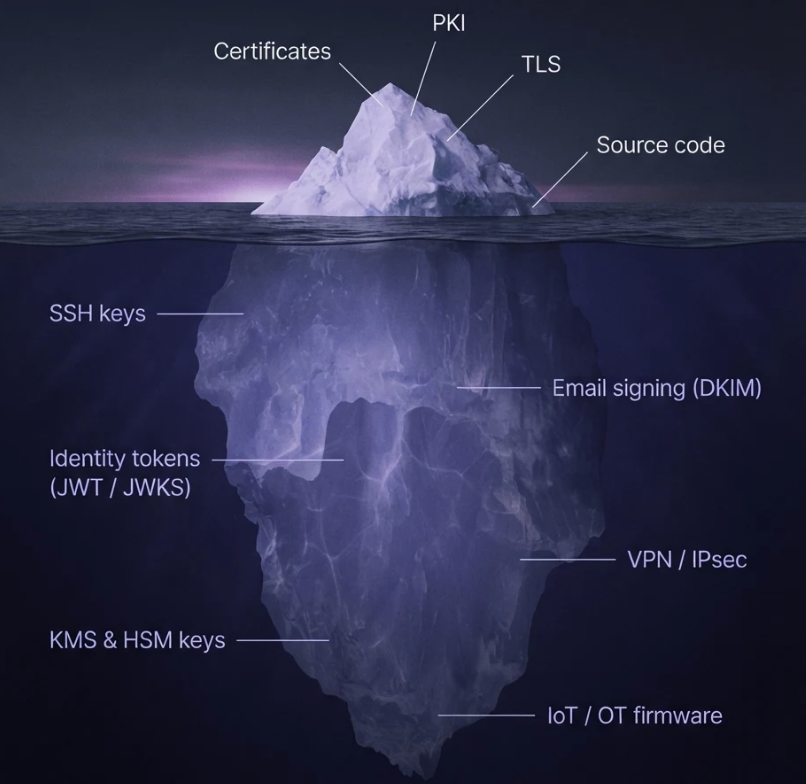
Below the waterline
Start with the most urgent quantum risk: harvest now, decrypt later. It targets key exchange, the moment two systems agree on a session key. In TLS, that exchange uses ephemeral keys that never appear in a certificate. The certificate only authenticates the server. You can have a perfectly managed certificate estate and still be leaking every session to a future quantum adversary.
Then look at everything else that relies on quantum-vulnerable public-key cryptography without ever touching your PKI:
- SSH. Host keys and user keys, often generated years ago, copied between servers, and owned by nobody.
- Identity tokens. JWTs signed with RSA or elliptic-curve keys, published through JWKS endpoints, and trusted by every service that consumes them.
- Key management services. Asymmetric keys in cloud KMS and HSMs used for signing and key wrapping. The symmetric keys are fine; the keys that protect them often aren't.
- Email. DKIM signatures are RSA signatures, managed in DNS rather than in any certificate tool.
- Databases. Encryption at rest whose keys are wrapped with RSA or ECDH, plus client connections that negotiate their own key exchange.
- Source code. Cryptographic calls hardcoded into applications, pinned to old library versions, invisible to anything that scans infrastructure.
- IoT and OT. Firmware signing keys burned into devices with 15 to 20 year lifespans, running protocols no certificate manager has heard of.
None of these show up in a certificate lifecycle dashboard. Together they are usually most of the problem.
What we see in the field
All three examples below come from real client environments we've assessed. Each is a weakness today, before any quantum computer exists, and each sits where a certificate-centric programme would never look. That makes them a useful test.
- RSA-1024 DKIM keys. Email signing keys sit in DNS TXT records, set up by whoever configured the mail platform, often years ago. 1024-bit RSA has fallen short of NIST's guidance for over a decade, let alone quantum safety, and no certificate tool will ever flag it.
- AES in CBC mode. AES itself isn't the quantum problem. But CBC without proper authentication is open to padding-oracle attacks today. It turns up in application code, database encryption and legacy integrations, none of which PKI tooling looks at.
- SHA-1. Practical collisions have existed since 2017, and public CAs stopped issuing SHA-1 certificates years ago. Yet it persists in code, internal signing, integrity checks and legacy protocols, well outside the certificate estate.
The pattern is consistent: the certificate inventory is the part of the estate an organisation already knows best. If a programme can't see a 1024-bit DKIM key or a SHA-1 integrity check today, it won't see the quantum-vulnerable cryptography sitting right next to them.
Why the framing is risky
If the PKI framing were merely incomplete, it would be harmless. It isn't, for three reasons.
It produces false confidence. An organisation that equates PKI maturity with quantum readiness will build a dashboard that turns green while its real exposure sits untouched. Boards will be told the programme is on track. The harvested traffic keeps accumulating regardless.
It gets the sequencing wrong. "Fix PKI first, then replace algorithms" sounds prudent. But hybrid post-quantum key exchange is already shipping in major browsers, OpenSSL and recent OpenSSH releases. For much of the estate it's a library upgrade or a configuration change. Waiting for PKI maturity before switching it on means choosing to keep accumulating harvest-now-decrypt-later exposure for no good reason. The two workstreams should run in parallel.
It undersells the expertise required. Nobody needs a lattice mathematician. But someone does need to decide between ML-DSA, SLH-DSA and stateful hash-based signatures for firmware, and to understand what goes wrong when stateful signature state isn't managed perfectly. Someone needs to know why larger key shares break middleboxes, which HSMs actually support the new algorithms, and where the IETF drafts on hybrid and composite certificates are still moving. That isn't PKI operations, and it isn't academic research. It's applied cryptographic engineering, and it's scarce.
Start with the whole estate
The better starting point is not a certificate list. It's an inventory of every place your organisation uses cryptography: what algorithm, what key, who owns it, how long it needs to stay secure, and how long it would take to replace. That last pair is what actually sets your priorities. A short-lived TLS session key and a firmware root of trust fused into a device in the field are very different problems, even if both use the same elliptic curve.
PKI teams are essential to this work. They understand lifecycle, ownership and trust better than anyone else in the building, and they will carry a large share of the migration. But they are one team in a programme that spans infrastructure, application development, identity, cloud, OT and procurement.
So yes, fix your PKI. Then keep digging. The certificates are the part of the iceberg you can already see.