

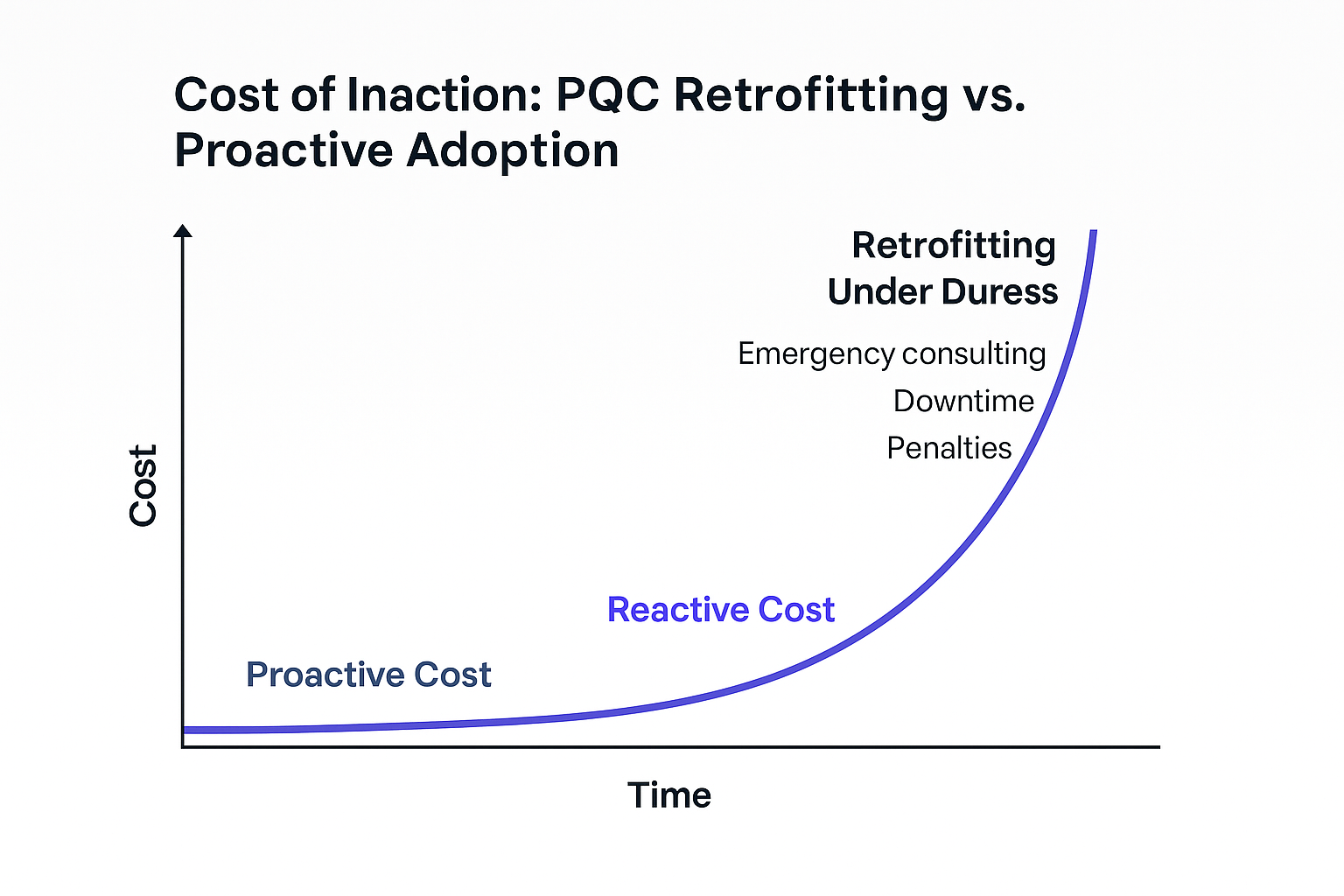
Cost of Inaction: PQC Retrofitting vs. Proactive Adoption

Cryptographic Sovereignty vs standardizaiton

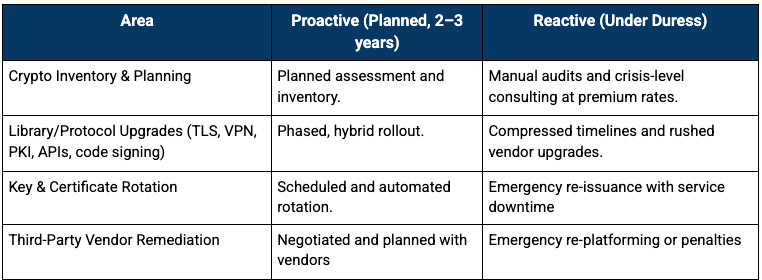
Why RetroFitting Under Duress is More Expensive.

When it comes to post-quantum cryptography (PQC), the biggest financial risk isn’t adopting too early, it’s waiting too long. Organisations that fail to prepare for quantum-safe migration will face urgent, unplanned retrofits once a quantum breakthrough or regulatory mandate hits. With 82% of enterprises underestimating migration costs by 3-5x according to 2025 MIT Digital Currency Initiative research; the cost to those who wait could be extortionate.  

At ExeQuantum, we apply our STAC Doctrine — Sovereignty, Transparency, Agility, Compliance — to help organisations make quantum transitions predictable, measurable, and cost-effective. The message is simple: the cost of inaction compounds faster than the cost of transformation.

Let’s break down why.

Proactive versus Reactive Migration:

Business Disruption Costs

‘Risk & Remediation Costs (if breached during lag)

Delaying PQC adoption isn’t just about higher upgrade costs. It creates a dangerous lag window where adversaries can exploit harvest-now-decrypt-later (HNDL) attacks. If a breach occurs during this period, remediation costs skyrocket:
• Data breach remediation: ~$140M (based on Optus precedent)
Regulatory fines: Up to $50M per serious/repeated breach (OAIC post-2022 amendments)
Reputation loss: Share price decline, mass customer churn (Optus lost >200,000 customers within six months)

For organisations with long data-retention lifecycles or regulated environments, quantum-safe security is no longer optional, but a core component of modernisation and long-term risk management.

Embedding the STAC Doctrine

At ExeQuantum, we use the STAC DoctrineSovereignty, Transparency, Agility, Compliance — as the foundation for PQC readiness.

Sovereignty: Maintain ownership and control over your cryptographic future. Build independence from vendor lock-in and external supply chain risk.
Transparency: Know where every cryptographic dependency lives across systems, APIs, and vendors, no blind spots, no assumptions.
Agility: Design crypto-agile architectures that enable seamless algorithm swaps and hybrid PQC deployment without disruption.
Compliance: Align early and stay compliant with NIST PQC standards and evolving APRA/OAIC mandates, ensuring regulatory resilience before the rush.

This approach turns PQC from a reactive compliance burden into a strategic capability, one that strengthens your trust posture and competitive position.

We can pay a little now, or a lot later. PQC is your future proofed insurance.

Post-Quantum Cryptography (PQC) Investment FAQ’s

Why spend now if Quantum computers aren't here yet?

Attackers are already stealing encrypted data today (“harvest now, decrypt later”). Sensitive data like health, identity and financial records remain valuable for decades. If we don’t migrate early, that data is at risk the moment quantum capability arrives.

Can’t we just upgrade when the standards are final?

NIST has already standardised core PQC algorithms (ML-KEM, ML-DSA, SLH-DSA). Waiting means you will be forced into an emergency migration, competing with every other enterprise and vendor for the same scarce expertise.

What’s the actual business risk if we delay?

Inaction exposes you to:
- Breach liability of $50M-$150M+ (based on Optus/Medibank precedents).
- OAIC/APRA non-compliance fines of up to $50M.
- Loss of customer trust and market share.
- Higher insurance premiums and possible loss of cover.

What do we get for the money today?

- Complete crypto inventory (you may not know where all RSA/ECC is used).
- Hybrid TLS and PQC pilots; demonstrating customer-facing leadership.
- Crypto-agile infrastructure that reduces lock-in and improves overall cyber maturity.
- Third-party supplier uplift clauses; closing one of our biggest breach vectors.

What’s the competitive upside?

Early movers can market PQC readiness as a trust differentiator, particularly in financial services, healthcare, and critical infrastructure. Customers and regulators will favour organisations that are demonstrably “future-proof.”