Crypto Agility: Why AI Attacks Demand Faster Change
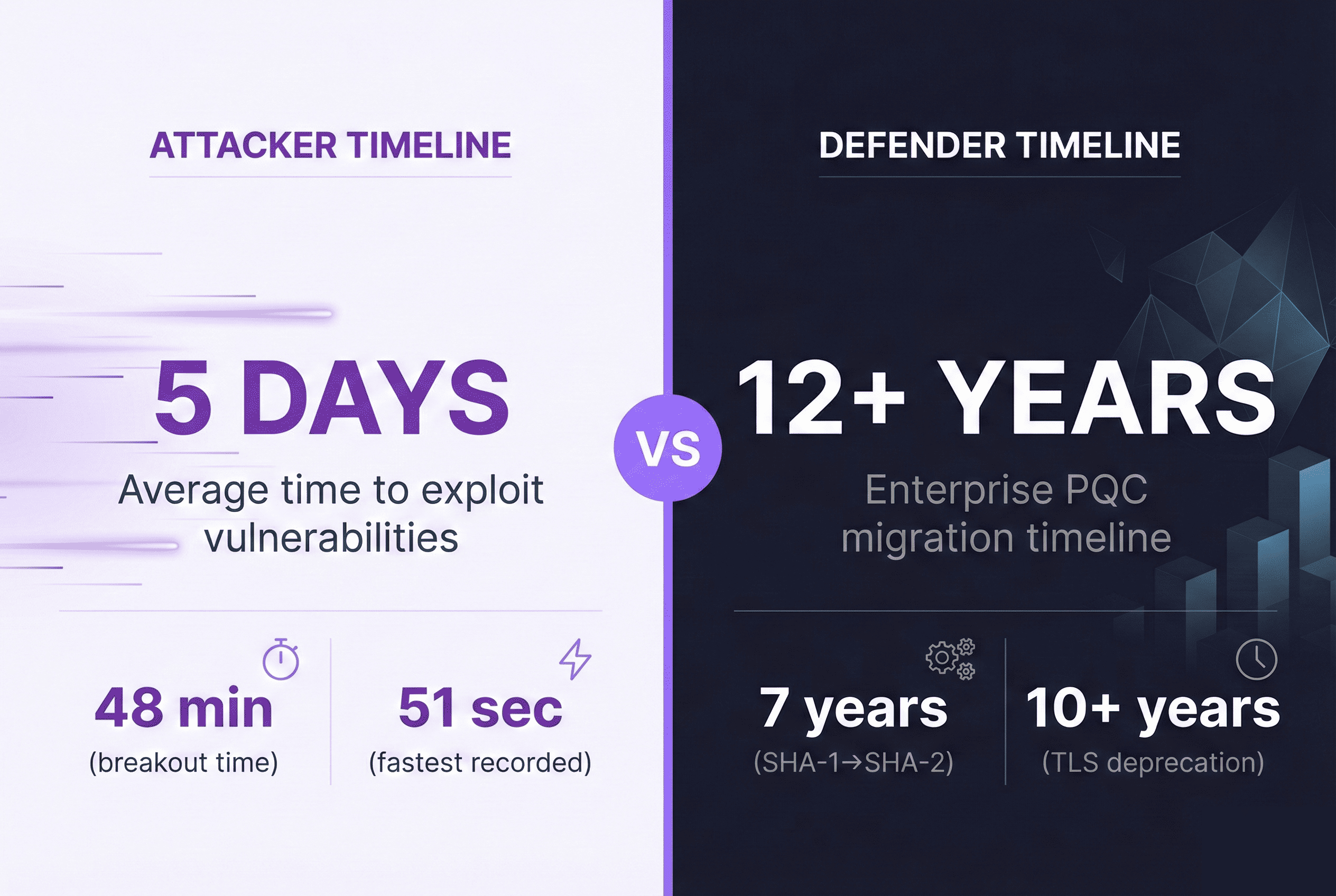
Google Mandiant reports that attackers now exploit vulnerabilities within 5 days of disclosure. Yet enterprise cryptographic migrations consistently require 12 to 15 years to complete. This gap between attacker speed and defender response defines the central challenge facing security leaders today.
The rise of AI-powered attacks has compressed this timeline further. Agentic AI systems can now execute entire attack campaigns with minimal human intervention, making decisions in milliseconds that once required hours of manual effort. For organizations still running quarterly cryptographic change cycles, the math no longer works. The question is not whether to adopt crypto agility (the capability to rapidly swap encryption algorithms without system disruption), but whether there is still time to do so before the next algorithm deprecation or quantum breakthrough forces the issue.
The Speed Gap: Attackers Move in Minutes, Defenders in Years
The asymmetry between attack and defense timelines has reached a critical inflection point. Consider the numbers: VulnCheck documented 768 CVEs publicly exploited in 2024, with 23.6% exploited on or before the disclosure day itself. CrowdStrike's 2025 Global Threat Report records an average breakout time of just 48 minutes from initial access to lateral movement. The fastest recorded breakout was 51 seconds.
Meanwhile, defenders operate on fundamentally different timescales. The SHA-1 to SHA-2 migration took approximately 7 years despite browser vendors forcing the transition by rejecting SHA-1 certificates. TLS 1.0 and TLS 1.1 deprecation has stretched beyond 10 years and remains incomplete, with Qualys SSL Labs reporting that 28 to 30% of websites still support deprecated protocols. AWS completed its TLS deprecation only in February 2024.
This disparity extends to cryptographic infrastructure specifically. Academic research from MDPI (December 2024) projects that large enterprises with more than 5,000 employees require 12 to 15 years for full post-quantum cryptography migration under baseline assumptions. Pessimistic scenarios extend this to 20 years. The implication is clear: organizations cannot rely on reactive cryptographic change processes when attackers adapt in hours.
The Cryptographic Change Velocity Gap
Security teams track Mean Time to Detect (MTTD) and Mean Time to Contain (MTTC) as core operational metrics. Yet few organizations measure what may be the most consequential metric for long-term security posture: cryptographic change velocity. This metric captures how quickly an organization can modify its cryptographic infrastructure in response to new requirements, whether from vulnerability disclosure, regulatory mandate, or algorithm deprecation.
The contrast between attacker and defender crypto change velocity reveals the structural disadvantage most organizations face:
Attackers operate with near-instantaneous crypto agility. They select algorithms, generate keys, and deploy payloads within their automated toolchains. Defenders, by contrast, must navigate change advisory boards, vendor coordination, regression testing, and compliance documentation. The result: attackers can exploit cryptographic weaknesses faster than defenders can remediate them.
Why Static Crypto Change Cycles No Longer Work
Most enterprises approach cryptographic change as a periodic project rather than a continuous capability. Certificate rotations happen on fixed schedules. Algorithm upgrades wait for major system refreshes. Key management policies remain unchanged for years. This approach made sense when cryptographic standards evolved slowly and attack timelines measured in months.
Today, this model creates compounding risk. Certificate management failures already cause significant operational impact. Keyfactor research shows 86% of companies suffered at least one outage due to expired or mismanaged certificates in the past year, with 31% reporting outages at least quarterly. The average economic loss from certificate incidents reaches $11.1 million, requiring 8 to 11 team members and over 5 hours to identify and remediate.
The regulatory environment adds urgency. The CA/Browser Forum has mandated 47-day maximum certificate validity by March 2029, down from 13 months currently. Organizations lacking automation face exponentially increasing operational burden as rotation frequency increases. Meanwhile, NIST's post-quantum cryptography standards (FIPS 203, 204, 205) establish hard deadlines: classical algorithms face deprecation after 2030 and disallowance after 2035.
What Crypto Agility Means in Operational Terms
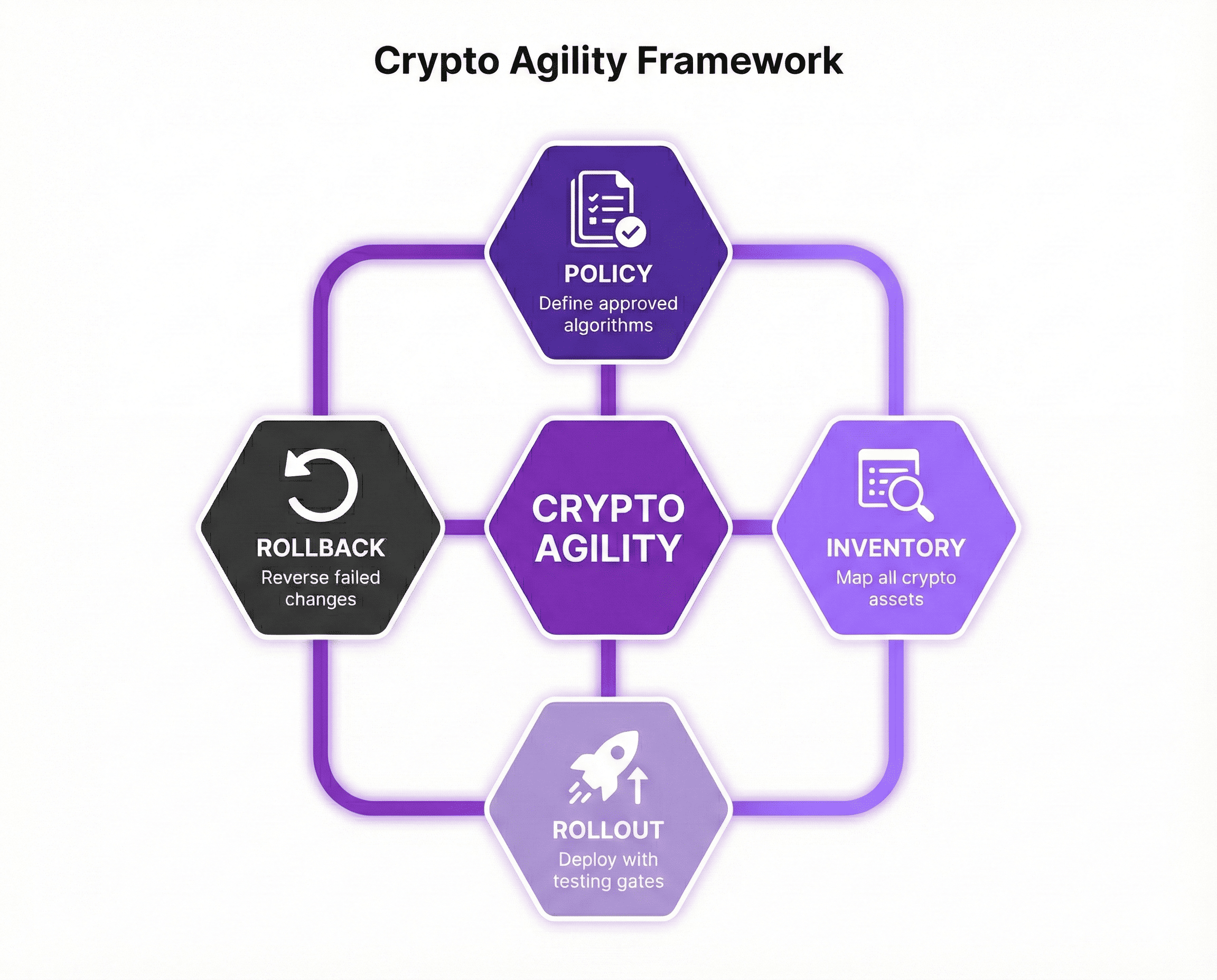
Gartner defines crypto agility as the capability to transparently swap out encryption algorithms and related artifacts in an application, replacing them with newer and safer alternatives. In practice, this requires capabilities across four domains: policy, inventory, rollout, and rollback.
Policy defines which algorithms are approved, deprecated, or prohibited across the organization. Without centralized policy management, individual teams make inconsistent decisions that create hidden dependencies on vulnerable cryptography.
Inventory provides visibility into where cryptography exists across the environment. Entrust and Ponemon Institute research shows 43% of organizations cannot inventory their cryptographic assets. You cannot migrate what you cannot find.
Rollout enables phased deployment of new algorithms with appropriate testing gates. Venafi reports only 8% of security leaders fully automate all aspects of TLS certificate management, while 29% still rely on spreadsheets.
Rollback ensures failed changes can be reversed quickly without extended outages. This capability becomes critical during algorithm transitions where compatibility issues may only surface in production.
Building Agility Without Chaos
The path to crypto agility does not require replacing existing infrastructure overnight. Instead, organizations can adopt a phased approach that builds capability incrementally while reducing immediate risk.
Start with discovery. Automated cryptographic inventory tools can map certificates, keys, and algorithm usage across infrastructure. This visibility reveals both the scope of migration required and the highest-priority systems to address first. NIST's NCCoE has identified cryptographic discovery as the primary barrier to post-quantum migration.
Establish guardrails. Policy-as-code approaches enable centralized definition of approved algorithms with automated enforcement. When a team attempts to deploy deprecated cryptography, the system blocks the change before it reaches production.
Automate rotation. Manual certificate deployment averages 2 to 3 working days compared to under one hour with automation. As certificate lifespans shrink, automation becomes not optional but essential for operational viability.
Test continuously. Crypto agility requires confidence that algorithm changes will not break dependent systems. Automated testing pipelines that validate cryptographic changes against application functionality provide this assurance.
When This Becomes a Board-Level Issue
Cryptographic agility typically operates below executive visibility until a triggering event forces attention. Security leaders should anticipate these scenarios:
A competitor announces post-quantum readiness and wins a major contract where cryptographic posture was an evaluation criterion
An AI-accelerated breach makes news and the board asks whether similar attacks could exploit your cryptographic infrastructure
A regulatory audit flags static cryptographic change cycles as a control gap requiring remediation
The diagnostic question every CISO should be able to answer: How long would it take your organization to rotate every cryptographic key if NIST deprecated RSA tomorrow? If the answer is measured in years rather than weeks, the gap between attacker capability and defender response has already become a material risk.
The Simplest Starting Point This Quarter
Organizations seeking to improve crypto agility can begin with a focused assessment: inventory one critical system completely. Map every certificate, key, and algorithm dependency. Document the change process required to rotate each cryptographic asset. Measure the time from decision to deployment.
This exercise reveals the true crypto change velocity for your organization. It identifies manual steps that automation could eliminate. It surfaces dependencies on vendors or legacy systems that constrain agility. Most importantly, it provides concrete data to support investment in cryptographic infrastructure modernization.
Building Quantum-Resistant Security with ExeQuantum
Understanding your cryptographic exposure is only valuable if you can act on it. ExeQuantum's EQCore platform helps organizations discover, remediate, and govern their cryptography, transforming a hidden technical dependency into a measurable, auditable capability.
Our Agile architecture ensures you can update algorithms without infrastructure overhaul as standards evolve. Whether you need to respond to a sudden algorithm deprecation or prepare for post-quantum requirements, ExeQuantum supports cryptographic change that is controlled, repeatable, and sovereign by design.
Conclusion
The quantum threat timeline continues to compress as hardware advances and algorithm optimizations reduce the resources needed for cryptanalysis. Organizations that build crypto agility now position themselves ahead of regulatory mandates and the inevitable capacity crunch when the broader market recognizes the urgency. The math is straightforward: if your cryptographic change process takes longer than your patch cycle, you are already behind. Connect with ExeQuantum and understand how we help security teams build measurable, auditable crypto agility.
Contact us
Thank you! Your submission has been received!
Oops! Something went wrong while submitting the form.