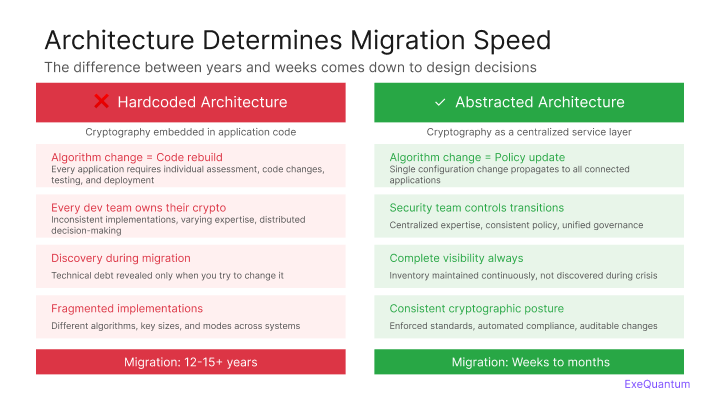
Why true cryptographic agility requires foundational decisions, not bolted-on solutions.
You cannot retrofit agility. Organisations that build abstraction today will change algorithms through configuration. The rest will explain why migration is taking another five years.
The biggest risk in post-quantum cryptography migration is not algorithmic. It is architectural. NIST’s 2035 deadline for deprecating RSA and elliptic curve cryptography collides with research showing large enterprises need 12 to 15 years for full cryptographic transitions. The math is unforgiving. As we explored in Where Does Your Cryptography Live?, organisations that cannot see their cryptography cannot change it. Those that treat crypto agility as a feature to add later face a vulnerability window where threats may materialise before migrations complete.
Why Cryptographic Migrations Take Decades
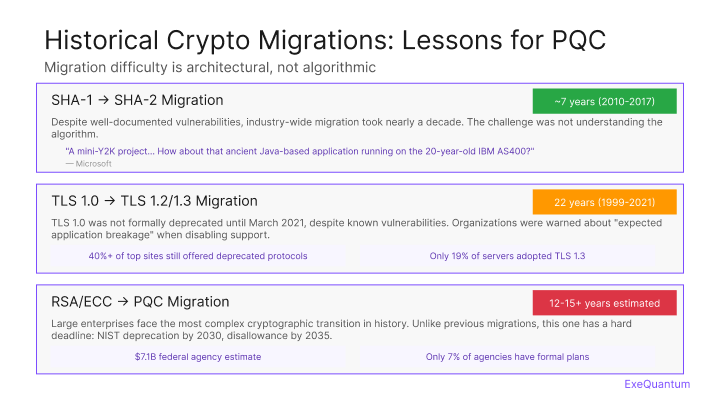
Historical transitions provide stark evidence that migration difficulty is fundamentally architectural, not algorithmic. The SHA-1 to SHA-2 migration took approximately seven years industry-wide, despite the vulnerability being well documented. Microsoft described this as a "mini-Y2K project," asking how ancient Java-based applications running on 20-year-old IBM AS/400s would handle SHA-2 certificates. The problem was never the cryptography. It was discovering where cryptography was embedded.
TLS 1.0, released in 1999, was not formally deprecated until March 2021—a 22-year lifespan for a protocol with known vulnerabilities. More than 40% of the top million websites still offered deprecated protocols at the time of deprecation. These delays were not resource constraints. They were architectural debt. As we explored in AI Attacks Move Fast, Your Cryptography Must Too, organisations discovered cryptographic choices hardcoded into applications, firmware, and third-party integrations across systems never designed for algorithm flexibility.
NIST’s definition confirms this architectural framing. NIST Cybersecurity Whitepaper 39, released December 2025, defines cryptographic agility as "the capabilities needed to replace and adapt cryptographic algorithms in protocols, applications, software, hardware, firmware, and infrastructures while preserving security and ongoing operations." The key word is capacity—an architectural property, not a feature toggle.
The Abstraction Layer Pattern
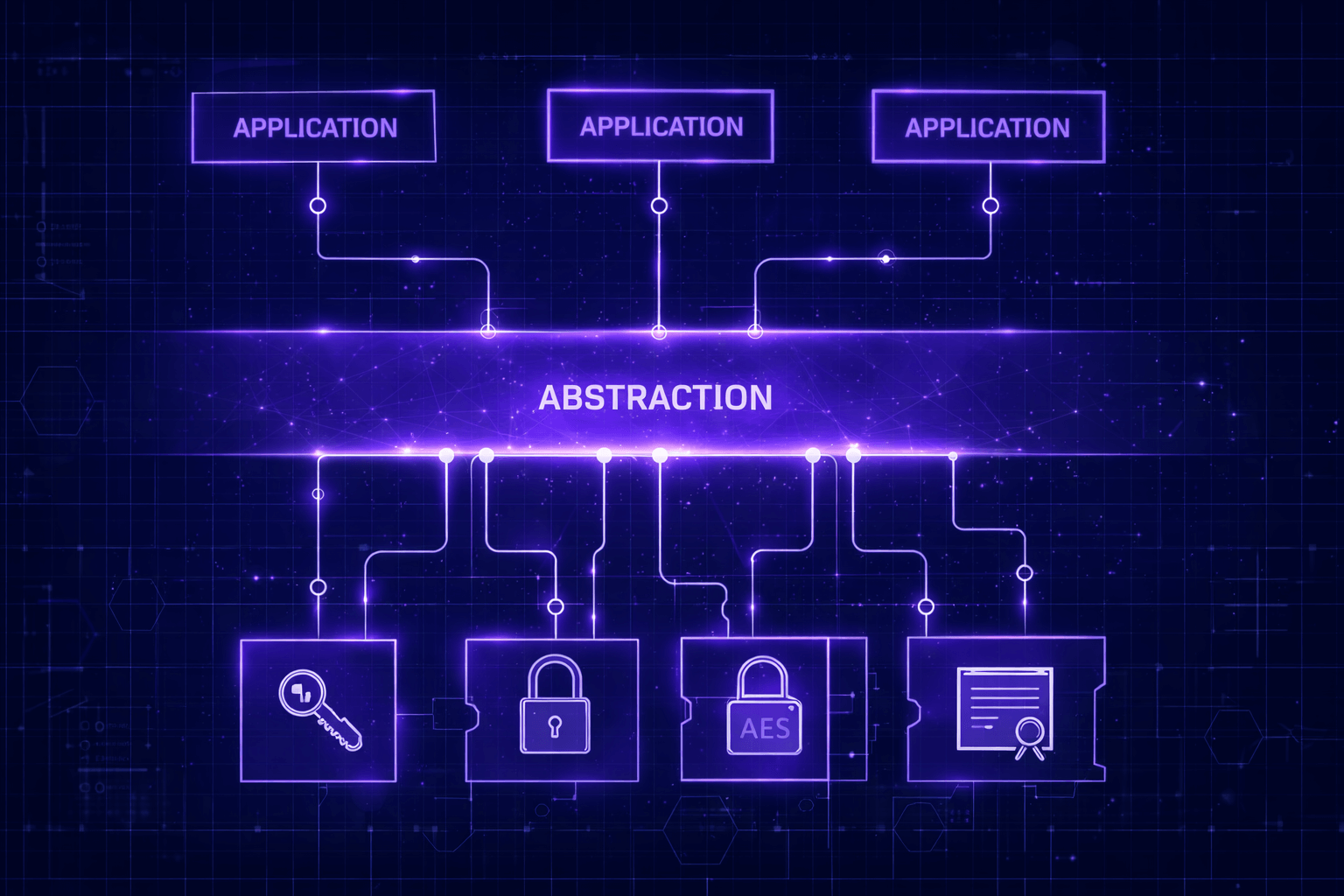
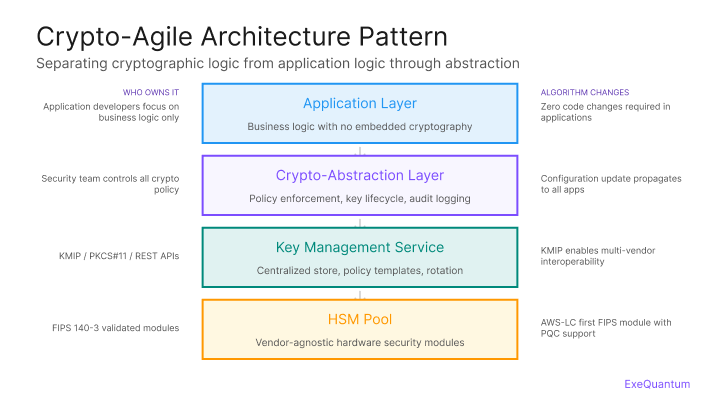
Enterprise architects achieving true crypto agility employ a consistent pattern: separating cryptographic logic from application logic through abstraction layers. Applications specify intent. Security teams manage implementation. This inverts the typical model where developers make cryptographic choices that become hardcoded technical debt.
The Key Management Interoperability Protocol (KMIP), the OASIS-governed standard supported by IBM, HP, Oracle, Thales, and Entrust, enables vendor-neutral key management. KMIP 2025 interoperability tests already cover post-quantum algorithms. Organisations adopting KMIP-based architectures can swap underlying HSM vendors or add PQC algorithms through configuration rather than code changes.
The leaders have already built this way. Google mandates the Tink crypto library as its primary abstraction layer, enabling ML-DSA migration as a key rotation rather than a code rewrite. Microsoft centralised cryptographic operations through SymCrypt across Windows, Azure, and Microsoft 365, targeting PQC completion by 2033. AWS’s AWS-LC library became the first open-source FIPS 140-3 validated module with PQC support. The critical enabler across all three: TLS 1.3 strictly mandated to use PQC at all.
This is why algorithm selection alone is insufficient. As we discussed in Why ML-KEM Only Is Not a Strategy, even the best algorithms cannot compensate for architectural limitations that prevent rapid deployment.
The Cost of Architectural Debt
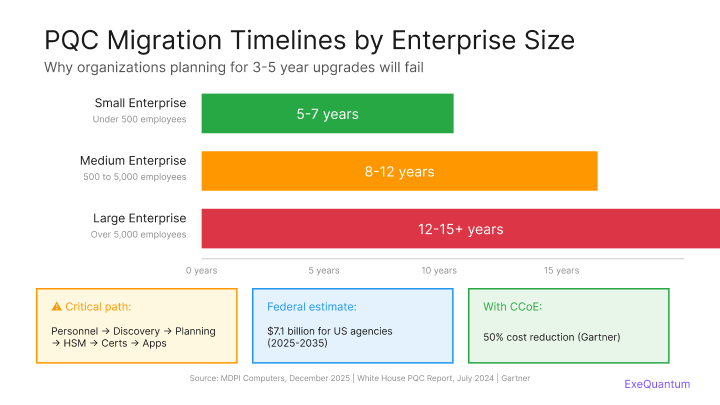
The White House estimates $7.1 billion for U.S. federal agencies to migrate to PQC between 2025 and 2035—excluding classified systems. MDPI research from December 2025 estimates enterprise timelines that make the stakes clear: small enterprises need 5 to 7 years, medium enterprises 8 to 12 years, and large enterprises 12 to 15 years or more. The research concludes that organisations planning for a 3-5 year upgrade will fail.
Gartner quantifies the architectural advantage: by 2028, organisations with a Crypto Centre of Excellence will save 50% of costs compared to those without. IBM’s Quantum Safe team confirms the mechanism: "A more agile cryptographic infrastructure would simplify this process by centralising and abstracting cryptography so that you can monitor and update it without digging into application code."
Organisations with crypto-agile architectures perform algorithm updates through policy file changes, not code deployments. Through key rotation operations, not application refactoring. Through configuration management, not regression testing thousands of applications.
Diagnostic Question: If NIST deprecated your primary encryption algorithm tomorrow, would your team update a configuration file or start a multi-year code refactoring project?
This architectural choice surfaces at the board level through predictable triggers. When your security team reports PQC migration will take 10 years but threats may materialise by 2029, the board will ask why systems were not designed for faster transitions. When a competitor announces PQC readiness through configuration changes while your team is scoping a multi-year project, the investment gap becomes visible.
Building Quantum-Resistant Security with ExeQuantum
The Agility pillar of ExeQuantum’s STAC Doctrine (Sovereign, Transparent, Agile, Compliant) addresses architectural readiness directly: the ability to change cryptographic implementations through configuration rather than reconstruction. As we introduced in Proof Beats Claims in the Quantum Transition, compliance increasingly demands this capability.
ExeQuantum’s PQCaaS platform provides the abstraction layer that separates cryptographic decisions from application code. Discover identifies where cryptography is embedded, revealing architectural debt before migration begins. Remediate enables algorithm transitions through centralised policy management. Govern maintains the abstraction layer over time, ensuring new applications connect to cryptographic services rather than embedding their own.
The goal is not just completing the PQC migration. It is building the architectural foundation for whatever cryptographic transitions come next. Organisations that invest in abstraction now will measure migrations in weeks. The rest will measure in years.
Ready to assess your cryptographic architecture? The Executive’s Guide to PQC Migration covers the architectural decisions that separate organisations completing migration in years from those still planning after a decade. Download the Executive’s Guide → exequantum.com/executive-guide
Contact us
Thank you! Your submission has been received!
Oops! Something went wrong while submitting the form.